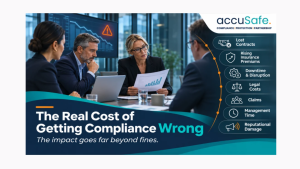
The Real Cost of Getting Compliance Wrong
Leadership Uncovered | 16 November 2026
Imagine sitting in your monthly senior leadership meeting. You’re working through the financial performance of the business, discussing rising operational costs, reviewing the sales pipeline and looking at opportunities for growth. Health and safety appears somewhere on the agenda, and you’re reassured that there have been no significant incidents, training is up to date and the risk assessments have been reviewed.
Nothing particularly concerning there, so you move on.
But how much do you actually know about the financial exposure of your organisation should something go wrong? And how confident are you that the money you’re already investing in health and safety is adequately protecting both your people and your business?
I think there’s still a tendency to associate the financial consequences of getting health and safety wrong with prosecution and fines. Whilst these are very real risks, they represent only part of a much bigger picture.
Getting it wrong isn’t necessarily just a slap on the wrist and onwards and upwards. It could fundamentally change the lives of the very people you’re supposed to protect, as well as the future of the business you’ve worked so hard to build.
The costs that don’t appear under health and safety
According to the Health and Safety Executive (HSE), the estimated economic cost of workplace injuries and new cases of work-related ill health in Great Britain was £22.9 billion in 2023/24. This figure accounts for both the financial costs and the human impact, including pain, suffering and reduced quality of life. Of that total, approximately £4.3 billion was borne by employers.
Interestingly, work-related ill health accounted for around 72% of the overall cost. So, whilst serious accidents understandably attract considerable attention, there is an equally important conversation to be had about the less visible health risks within our organisations.
What makes the financial impact particularly difficult for leaders to appreciate is that many of the costs associated with poor health and safety management are absorbed elsewhere in the business.
Think for a moment about the internal resources required following a serious workplace accident.
Your health and safety team is investigating the incident, establishing its root causes, reviewing existing arrangements and overseeing improvements. HR is dealing with absence, employee welfare and potentially complex employment matters. Finance is assessing the financial impact, looking at how losses can be mitigated and where savings might need to be made elsewhere in the business.
Your operational teams may be dealing with production downtime, rescheduling work, arranging additional staffing and managing customer expectations. Meanwhile, your senior leadership team is diverted from its strategic priorities to deal with the fallout.
All of this takes time, and all of it costs money.
What’s more, these costs rarely appear collectively on a single financial report. Increased sickness absence appears within HR reporting. Overtime and temporary staffing costs sit within operational budgets. Rising insurance premiums are picked up by finance, whilst lost business opportunities are discussed by the commercial team.
Each department may be dealing with a consequence of the same underlying management failure, without anyone making the connection or appreciating the cumulative cost to the organisation.
Surely there’s a compelling business case for getting all your ducks in a row from the outset?
Having effective health and safety management arrangements in place doesn’t guarantee that you’ll never have an accident. It does, however, help reduce the likelihood of one occurring and the risk of having to divert valuable resources away from growing the business to dealing with something that might have been prevented.
When one incident becomes a much bigger business problem
Let’s consider a hypothetical example of a manufacturing business where an employee suffers a serious injury whilst operating a piece of machinery.
Beyond the immediate consequences for the employee and the internal resources required to respond, the organisation may find itself facing legal costs, enforcement action, a compensation claim and significant expenditure on remedial work.
Orders may be delayed, contractual commitments missed and customers left questioning the reliability of their supplier.
Now imagine that this business is also tendering for a substantial new contract. It’s an opportunity that could facilitate further expansion, create new jobs and significantly increase turnover. However, as part of its due diligence process, the prospective customer asks about the organisation’s accident history, enforcement action and health and safety management arrangements.
What was initially regarded as an operational incident could now compromise the organisation’s growth strategy.
Even without a prosecution, the business could find itself under considerable financial pressure. A fine, should there be one, may not ultimately be its greatest loss.
Surely that’s what we have insurance for?
Insurance is an essential part of managing business risk, but it’s important that leaders understand the distinction between having insurance and having adequate financial protection.
An employers’ liability policy can provide cover for compensation claims and associated legal costs arising from work-related injuries and ill health. However, not every cost associated with an incident will necessarily be covered by the organisation’s insurance arrangements.
There is also the potential impact on future insurance renewals. The Association of British Insurers identifies previous claims history as one of the factors influencing employers’ liability insurance premiums.
Depending on the circumstances and the insurer’s assessment of the risk, a business could face increased premiums or less favourable insurance terms, the financial implications of which may extend over several years.
When was the last time your health and safety lead, finance team and insurance broker sat down together to discuss your organisation’s exposure to risk?
Understanding what isn’t covered is arguably just as important as understanding what is.
What happens when people lose confidence in your business?
Reputational damage is difficult to quantify, particularly when it comes to opportunities that never materialise.
You may know when you’ve lost an existing contract, but you won’t necessarily know when a prospective customer has decided not to approach you because of something they’ve read about your organisation.
The same applies to recruitment. Attracting and retaining good people is already a challenge for many businesses. If your organisation develops a reputation for poor working conditions or for failing to respond to employee concerns, what impact might that have on your ability to recruit experienced, competent people?
Equally, consider the employees who remain with you following a serious incident. Their confidence in the organisation and its leadership may have been affected, particularly if concerns had previously been raised about the circumstances that led to the incident.
Trust takes time to establish, and rebuilding it will require considerably more than issuing a revised policy and asking everyone to undertake refresher training.
Delegating responsibility doesn’t remove your exposure
It’s entirely reasonable for directors and senior leaders to delegate day-to-day health and safety responsibilities. You have people within your organisation with specific roles and areas of expertise for a reason.
However, delegating those responsibilities and subsequently establishing whether they are being discharged effectively are two very different things.
Under Regulation 5 of the Management of Health and Safety at Work Regulations 1999, employers in Great Britain are required to establish and implement suitable arrangements for managing, monitoring and reviewing their preventive and protective measures.
There can also be personal legal consequences. Section 37 of the Health and Safety at Work etc. Act 1974 makes provision for the prosecution of certain individuals where an offence by the organisation has been committed with their consent or connivance, or is attributable to neglect on their part.
You don’t need to become a health and safety specialist to lead your organisation effectively. You do, however, need sufficient understanding to recognise when something requires further scrutiny, when specialist advice is needed and when a decision requires your intervention.
What I’d like you to bring to your next leadership meeting
Rather than commissioning another report or introducing another set of performance indicators, I’d encourage you to select one significant health and safety risk within your organisation and work through three things with your leadership team.
1. Understand the potential consequences.
If the arrangements for controlling this risk were to fail, who could be harmed? What could it mean for your ability to operate, fulfil contractual obligations and maintain financial stability? Involve your finance and operational colleagues in that discussion.
2. Establish whether the risk is being effectively managed.
Ask to see evidence from the workplace, rather than relying solely on a policy or risk assessment. For machinery safety, for example, this might involve examining maintenance records, observing working practices and speaking to employees about what happens when equipment develops a fault.
You may discover that the arrangements look perfectly reasonable on paper but that operational pressures, inadequate resources or equipment problems are compromising their implementation.
3. Make an informed decision about any gaps.
Where weaknesses are identified, agree who will address them, what resources they need and how you will verify that the improvements have been effective. Where there is an immediate danger, protective action cannot wait until the next leadership meeting.
Repeat this exercise periodically with other significant risks. Over time, you’ll develop a much clearer understanding of both your operational and commercial exposure.
Protecting your people is part of protecting your business
When considering investment in health and safety, it’s very easy to focus on the immediate expenditure. The cost of training, specialist advice, additional equipment or preventative maintenance is visible, and there will always be other demands on the budget.
The cost of deciding not to invest is considerably less visible.
I’m not suggesting that every health and safety issue requires significant expenditure. Good management is also about proportionate decisions, understanding priorities and directing resources towards the areas where they will make a meaningful difference.
But before you defer an investment in health and safety, consider whether you’re making a genuine saving or simply leaving the business exposed to a potentially greater cost further down the line.
There is a very important moral and legal argument for protecting the people who work for you. There is also a compelling commercial one, and I don’t think we give it nearly enough attention in our leadership conversations.
One Question for Leaders
If one of your organisation’s most significant health and safety controls failed tomorrow, could your leadership team explain both the potential financial consequences and the evidence you currently have that the control is working?
Coming Up Next Week: The Best Leaders Ask Better Questions
Next week, we begin the sixth month of Leadership Uncovered, with a new theme: Becoming the Leader People Trust.
Strong leaders aren’t expected to know everything. They’re expected to ask the questions that reveal risk before it becomes a problem and seek expertise where it adds value.
We’ll explore why asking better questions is such an important leadership skill, how to challenge the assurances you’re given without undermining the people giving them, and why being comfortable admitting that you don’t have all the answers can actually strengthen people’s confidence in you as a leader.